
Jamiat Admin
- September 23, 2026
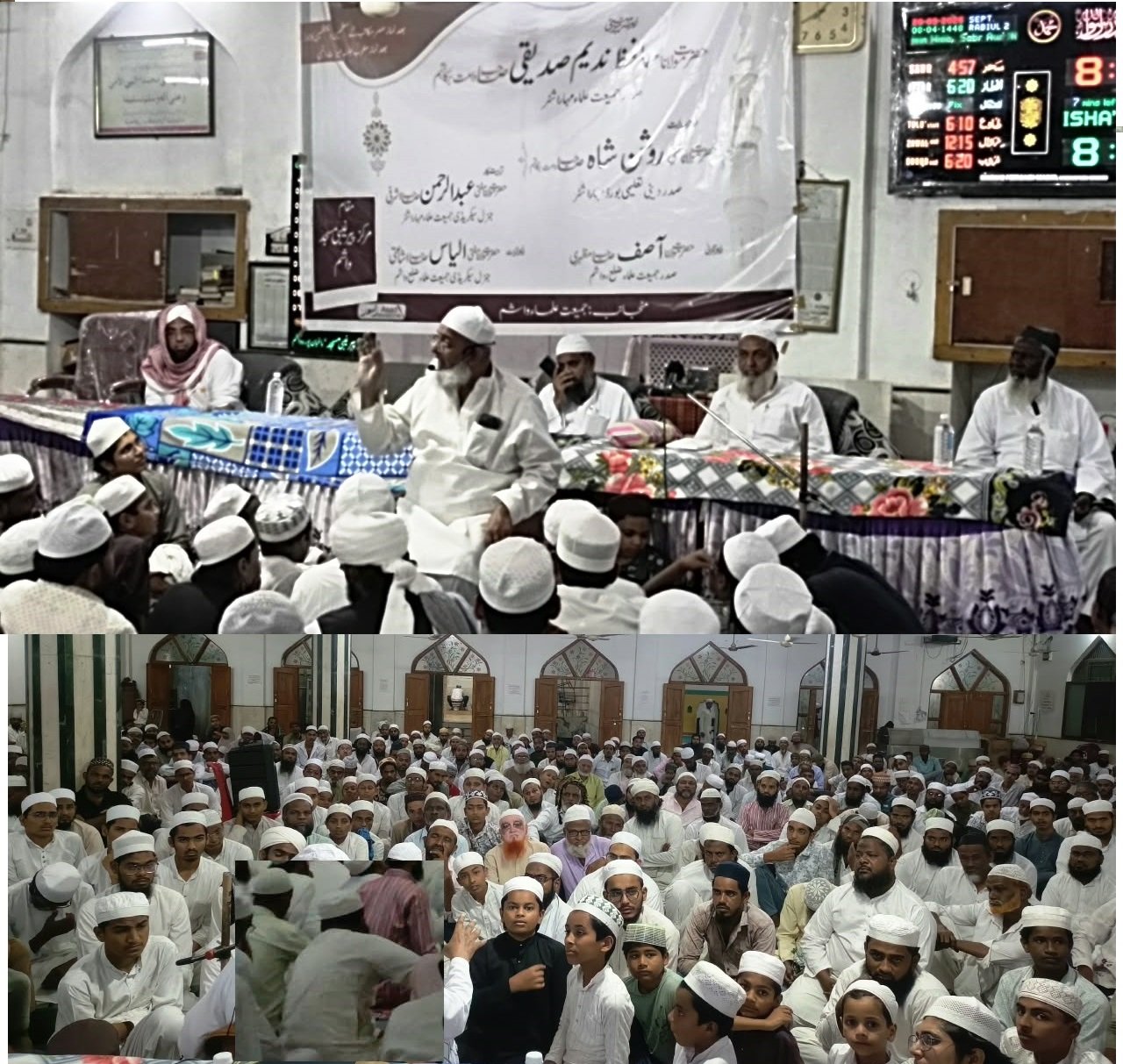
Addresses by Maulana Nadeem Siddiqui and others at a public gathering held in Washim for teachers of religious maktabs, mosque imams, and community leaders.
Washim: September 22, 2026
Programs are being organized across the province to further strengthen the system of religious maktabs (elementary Islamic schools), arrange religious education for children in every neighborhood and locality, train and guide maktabs teachers and mosque imams, create opportunities for religious education for adults and women, and strongly connect the new generation with the Holy Quran, prayers (Namaz), fasting, Islamic beliefs, essential rulings, and the Seerah (biography) of the Prophet (PBUH).
In this regard, a public gathering was recently held under the auspices of Jamiat Ulema at the Pir Ghaibi Mosque Center in Washim, presided over by Hazrat Maulana Hafiz Muhammad Nadeem Siddiqui (Patron of the Religious Education Board and President of Jamiat Ulema Maharashtra) and patronized by Hazrat Maulana Mufti Muhammad Roshan Shah Qasmi (President of the Religious Education Board, Jamiat Ulema Maharashtra). The event commenced with the recitation of the Holy Quran and Na’t (poetic praise of the Prophet). During the meeting, a firm resolve was expressed to continue organized and continuous efforts for the establishment and strengthening of religious maktabs in various areas of the Washim district, and to further expand the scope of religious education.
Speaking on the occasion, the president of the session, Maulana Hafiz Muhammad Nadeem Siddiqui, specially emphasized that the religious and moral upbringing of the new generation is not the responsibility of any single individual or institution alone. Rather, parents, mosque imams, teachers, scholars, religious institutions, and responsible members of society must all work together to fulfill this vital duty. He stated that equipping children with basic religious education alongside contemporary education is an urgent need of the hour. There is a need to continuously raise awareness regarding the establishment of maktabs in every neighborhood, the strengthening of existing maktabs, teacher training, regular attendance of children, and parental responsibilities.
Elaborating on the importance and necessity of religious maktabs, Maulana Mufti Muhammad Roshan Shah Qasmi stated that a maktab is the most effective and fundamental medium for children’s early religious education. If children are taught the Holy Quran, prayers, beliefs, Islamic manners, morals, and essential religious rulings from a young age, a strong foundation of attachment to religion and Islamic character can be established within them. He noted that in the present era, children’s maktabs alone are not enough; there is also a strong need to establish maktabs for adults and women, ensuring that no segment of society is deprived of religious education.
Addressing the maktab teachers, mosque imams, and community leaders, Maulana Mufti Abdul Rahman (General Secretary of Jamiat Ulema Marathwada) discussed their responsibilities, training, and organizational affairs. He clarified that a maktab is not merely a place to make children memorize a few chapters (Surahs) and supplications, but rather a primary center for building children’s faith, worship, morals, character, and Islamic personality. Therefore, teachers should adopt effective and accessible teaching methods keeping in mind the psychology, age, and mental capacity of the children.
This significant gathering was held under the supervision of Maulana Muhammad Asif, President of Jamiat Ulema Washim District, and under the leadership of Maulana Mufti Muhammad Ilyas, General Secretary of Jamiat Ulema Washim District. District officials expressed a strong commitment to further organizing the work of religious maktabs and extending the activities of the Religious Education Board to various parts of the district.
The meeting saw enthusiastic participation from Jamiat Ulema office-bearers and members from across the district, including Maulana Abdul Jabbar, Hafiz Yasin, Maulana Talha, Maulana Abdul Rahman, Maulana Salim, Anees, Engineer Muzammil, Maulana Nishat, Maulana Obaid, Mufti Yunus, Maulana Saeed, Maulana Abdul Wahid, Mufti Muhammad Amin, Engineer Salman, Maulana Tauhid, along with prominent scholars of Washim district, mosque imams, maktab teachers, and local leaders from various areas.
At the conclusion, participants renewed their pledge to promote religious education, establish and strengthen maktabs, train teachers, and connect the new generation with the Quran and Sunnah. The gathering concluded with a supplication (dua) led by Maulana Hafiz Muhammad Nadeem Siddiqui.